In the spring of 2009 I signed up to take the 20”x24” Polaroid
class at Mass Art. During my time at Mass Art everyone recommended that I take
the class but I was very hard headed and cheap. In the class you only get to
take 5 images and each shot costs $75. Plus the camera can only do verticals. I
had thought that this class would be a waste of my time and money.
When it came time to register for classes, I had friends who
strongly recommend that I try the class. Their reasoning was “when will you
ever get the chance to work with this camera once you leave Mass Art”. Rita
Lombardi and Caitlin Duennebier were the two biggest influences to attempt this
course.
Artwork by Caitlin Duennebier
The 20x24 Polaroid class was very different from all the
other photography classes taught at Mass Art. We met for about three weeks went
over the camera, its history, lighting, and the business of photography. This
was the only business training mass art taught and it was in a single class
meeting. This knowledge alone was worth the tuition of the class. After our
first 3 meetings were over, a shooting schedule was made and off we went.
My new dilemma was “what to shoot”. I had never worked in a
studio environment before and was clueless on what I would work on for my
shoot. I have always doodled and drawn silly cartoons and thought this would be
a great opportunity to make them a reality with photography. I decided to
combine real people with cartoon elements in themes revolving around and in the
ocean. About the same time of my class I was reading “20,000 Leagues Under the
Sea” by
Jules Verne.
This novel along with the silliness of “The Life Aquatic” by Wes Anderson was
great inspiration in developing each one of my shots.

Untitled, John 2009 © Traverse Day Robinette
Thus “The Seven Seas” was born. I worked in a sketch book
drawing out each shot of how I wanted the model to stand and the positions for
lighting. Again this was all very new and different from any form of portraiture
I have done. I wanted the props to be made from white cardboard with the
details drawn in with a black marker. I was not concerned with hiding the
sticks supporting the props other than painting them black. The purpose of this
was to keep the images looking as much like a cartoon as possible.
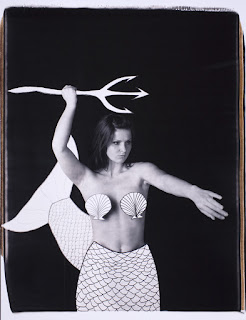
Untitled, Katrina 2009 © Traverse Day Robinette
As my shoot approached I worked on drawing and cutting out
the props which turned out to be very time intensive. The night of my shoot was
chaotic and amazing. It was like being on a movie set and I was the director. I
told the models what to do and had many extras help with holding props into the
frame. I honestly don’t remember everyone who was in the room that night, but many
people helped and without their help the shoot would not have gone as smoothly
as it did.
Untitled, Melissa 2009 © Traverse Day Robinette
I attempted two horizontals. The camera is built to only
take verticals and is so large you can not lift and turn the camera on its
side. This leaves only one option, you have to change the way your subject
inters the frame. The toughest was a self-portrait where I laid half of my body
on a box and had my feet held so I could be in the frame. The other was of Wole
lying on his back with his legs up in the air and I turned the image after the
shot was made.
Untitled, Self Portrait 2009 © Traverse Day Robinette
Untitled, Wole 2009 © Traverse Day Robinette
The shoot lasted about two hours and was over before I knew
it. Once everything started rolling it went so fast. Months of planning coming
together at last and it was over before I knew it. The photographs hung on the
wall to dry, friends said their goodbyes and I was alone in an empty room with
my five images. I was mentally and physically drained from the demand of the
shoot. Yet I sat there on a high for what a rush it was to work with that
gigantic camera!


